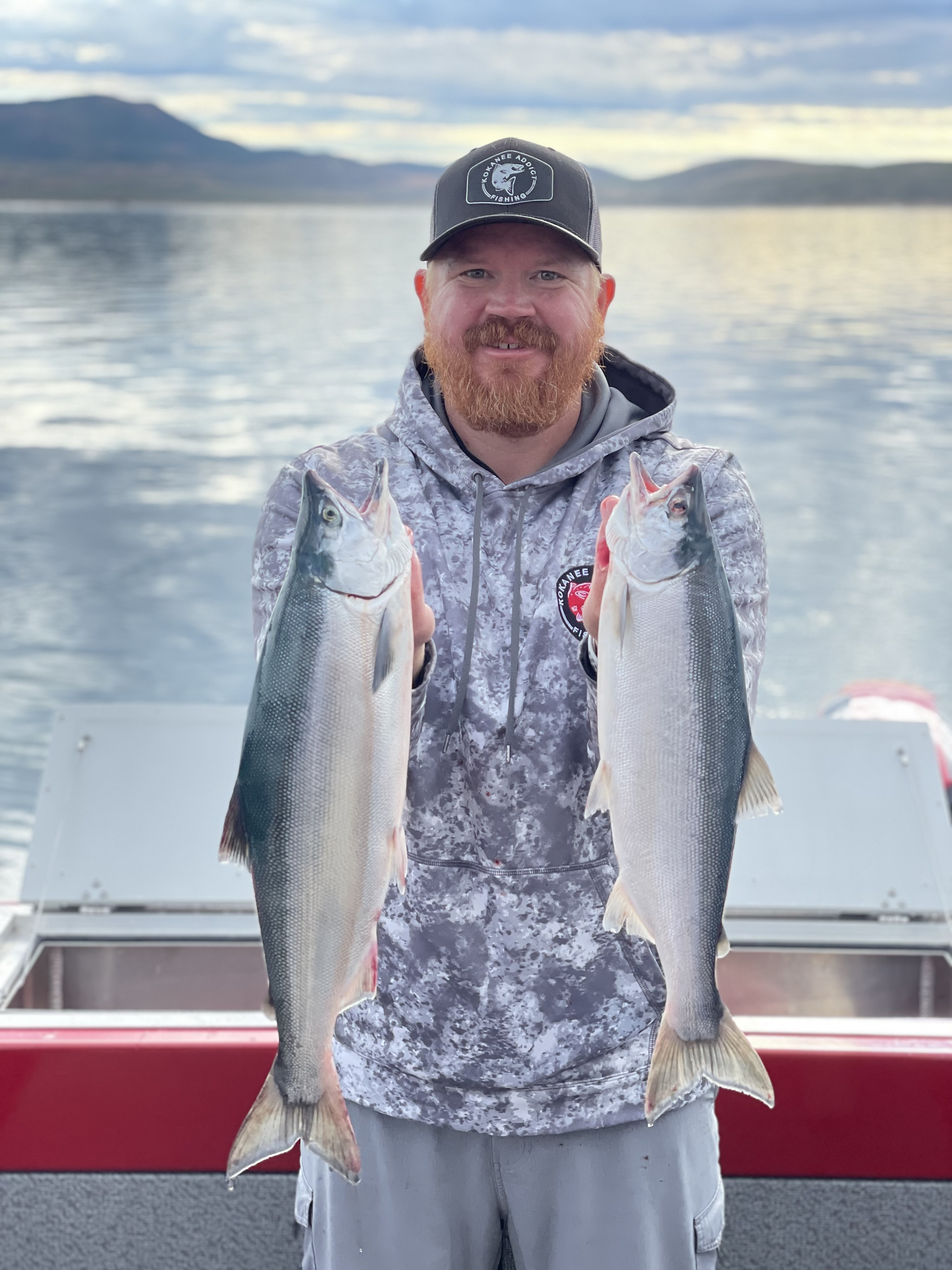

Where to Start
We have all had to start somewhere. Some people reading this may be experienced fishermen wanting to learn how to fish for kokanee. Others may have been fishing for kokanee for a while but want to learn what products and techniques work for someone else. Or you may be just starting out.
I have learned to fish the way I do from a combination of research, trial and error, and great advice from other successful fishermen. I always enjoy fishing with other fishermen to see how they fish. I have learned that just because someone does things different than I may, doesn’t mean it won’t work.
I believe there is no right or wrong way to catch kokanee — just “best practices”. My hope in putting together this guide is to provide some of those best practices that I have found success with to help jumpstart or add to your kokanee fishing techniques.
Kokanee Lifecycle
To help understand how to catch kokanee, let’s start with a biology lesson. Kokanee salmon are the landlocked version of sockeye salmon. While sockeye spend part of their life in the ocean, kokanee complete their entire lifecycle in freshwater lakes and their tributary streams.
Here are the key things to understand about kokanee behavior:
- They’re temperature sensitive. Kokanee prefer water between 48–54°F. In summer, that ideal temperature band might be 30–50 feet down. In early spring or winter, they can be found in the top 10–15 feet.
- They’re schooling fish. If you see a single fish on your fish finder but a bunch together somewhere else, target the depth where you’re consistently seeing multiple fish.
- They eat zooplankton. Unlike other species, we aren’t trying to match what they’re eating. Kokanee are aggressive and will strike when something unwanted enters their space. We’re literally trying to make them mad and trigger a strike.
- They have soft mouths. This is critical for gear selection later — you need light, flexible rods to avoid ripping the hook out.
- They spawn in the fall. During the spawn they come into shallower water near gravel beds and river inlets. Depending on where you live, they may be off limits during this time.
Do I Need a Boat?
Kokanee will primarily be in deeper parts of the lake. During the main summer season (roughly May through August), I am primarily fishing for them in the 25–45 foot depth range. Because of this, you really need a boat or other flotation device and a way to present your lure at a targeted depth.
The exceptions are during the fall spawn when they come closer to shore near gravel beds and river inlets. During those few weeks they can be caught from the bank. You can also catch them through the ice in wintertime.
So, do you need a boat? If you want to consistently catch kokanee during the summer months, the answer is yes. But that boat could be a kayak, a float tube, or a raft. For trolling (my preferred method) you need to be able to consistently move at about 1.2–1.8 mph either from a motor or human power.
For larger lakes I recommend a boat in the 18 ft+ range. I would also recommend an outboard motor so you can use it year-round without the complications of having to winterize an inboard.
What’s Next in This Course
Now that you understand what kokanee are and how they behave, the rest of this course will build on this foundation:
- Essential Gear — The minimum rod, reel, line, and net you need to get started
- Lures, Dodgers & Bait — What actually triggers bites
- Downrigger Basics — Getting your lure to the right depth
- Electronics & Fish Finders — Finding the thermocline and the fish
- Rigging Your Setup — How to tie it all together
- On the Water — Trolling speed, time of day, and the keys to success